Paperwork and money
GHIC, insurance and taking medicines abroad: the paperwork
Three documents do most of the work: the card that gets you seen, the policy that pays, and the labelling that lets you carry your own medicines across a border. Here is what each one requires and where each one fails.
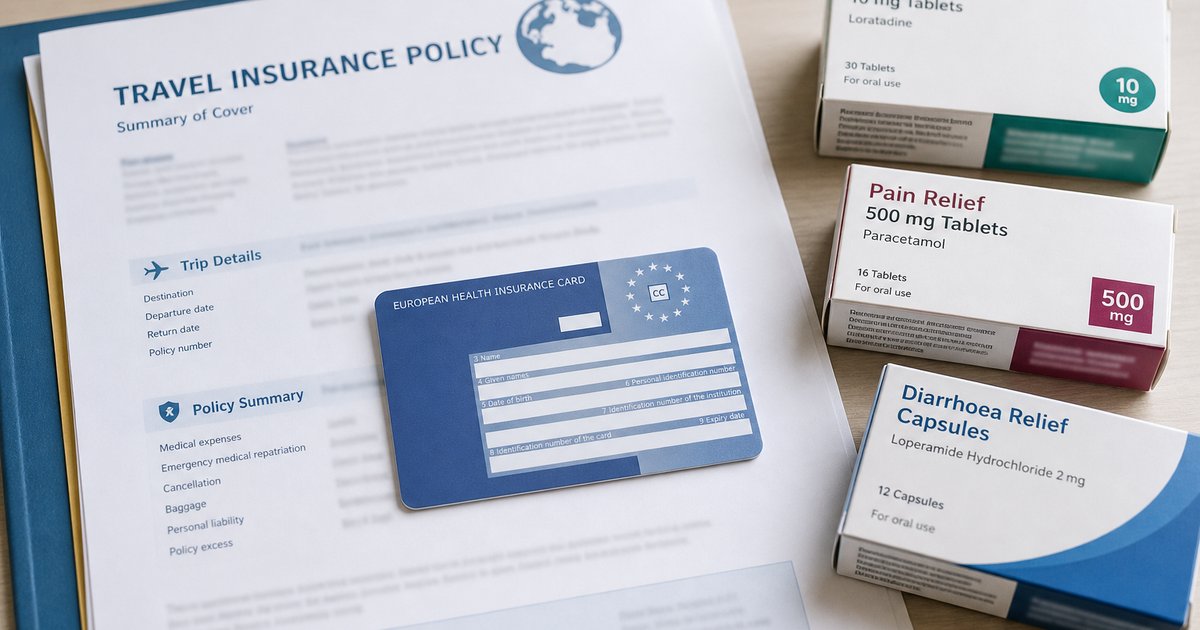
In short
- The GHIC is free from the NHS. Any site charging a fee is a copycat.
- It covers the named holder only; every traveller including children needs their own.
- A Provisional Replacement Certificate gives the same cover if you do not have the card with you.
- Keep medicines in original labelled packaging and carry a generic-name list.
The GHIC
Applying
Apply through the official NHS service. It is free, it always has been free, and any website charging an application fee is a copycat operation. You will need your National Insurance number and personal details. The card arrives by post, so allow a few weeks.
If you already hold a UK EHIC that has not expired, keep using it — it remains valid to its printed expiry date and in some circumstances has slightly wider coverage. You can apply for a replacement up to nine months before your current card expires, which is the sensible way to avoid a gap.
What it does
It entitles you to medically necessary state healthcare in participating countries on the same basis as a local resident. "Medically necessary" means treatment that cannot reasonably wait until you return home; the clinician in the country decides. "On the same basis as a local" is the part people miss: if residents pay a share of the cost, so do you. In some countries you pay up front and reclaim locally.
What it does not do
- Repatriation to the UK, in any circumstance
- Treatment in private hospitals and clinics
- Mountain and ski rescue
- Cruise ship medical facilities
- Cancellation, curtailment or lost baggage
- Anything at all outside participating countries
If you need treatment and do not have the card with you, apply for a Provisional Replacement Certificate, which gives the same entitlement.
Travel insurance
What to check before buying
- Medical cover limit and repatriation. These are the numbers that matter; baggage limits are a distraction.
- Pre-existing conditions. Declare everything. If the quote becomes unaffordable, use a specialist medical travel insurer rather than omitting a condition.
- Destination list. Annual policies often exclude regions or cap trip length.
- Activities. Winter sports, diving, motorcycling and even some hiking altitudes need specific cover.
- Excess. Check whether using a GHIC reduces or waives it — many policies do.
- The 24-hour assistance number. Save it offline. It is useless in a phone you cannot charge or a signal you do not have.
If you need to claim
Contact the insurer's assistance line before or as soon as treatment starts where you can. Many policies require prior authorisation for anything beyond minor treatment, and paying privately without telling them is a common route to a reduced settlement. Keep every receipt, discharge note and prescription.
Taking medicines abroad
The basics
- Take enough for the whole trip plus a margin for delays.
- Keep everything in its original packaging with the dispensing label attached.
- Carry it in hand luggage; split the supply across two bags where quantity allows.
- Ask your GP or pharmacist for a printed list of your medicines using generic names, since brand names differ internationally.
Restricted and controlled medicines
Some medicines that are routine in the UK are controlled or prohibited elsewhere, including certain strong painkillers, sleeping tablets and stimulant medications used for ADHD. Rules vary widely and penalties in some countries are severe. Check with the destination's embassy or consulate well in advance, because some require an import permit or a specific form of doctor's letter, and neither can be arranged the day before.
Practical points people miss
- Time zones shift dosing schedules. Ask the pharmacist how to handle it for time-critical medicines.
- Heat degrades some medicines, and insulin and similar products need a cool bag rather than a hot car boot.
- Ordering a repeat prescription early for travel usually needs a note to the practice explaining why; do it a fortnight ahead.
Common questions
Is the GHIC valid everywhere in Europe?
It covers the EEA and some other countries, but arrangements differ and the list changes. Check the current country list before travelling.
Do children need their own GHIC?
Yes. The card covers only the named holder.
Can I use a GHIC to travel abroad specifically for treatment?
No. It covers treatment that becomes necessary while you are there, not planned treatment you travelled for.
What if my medication is banned at my destination?
Speak to your GP well before travelling. There may be an alternative that is permitted, or a permit process, but neither is a last-minute fix.